

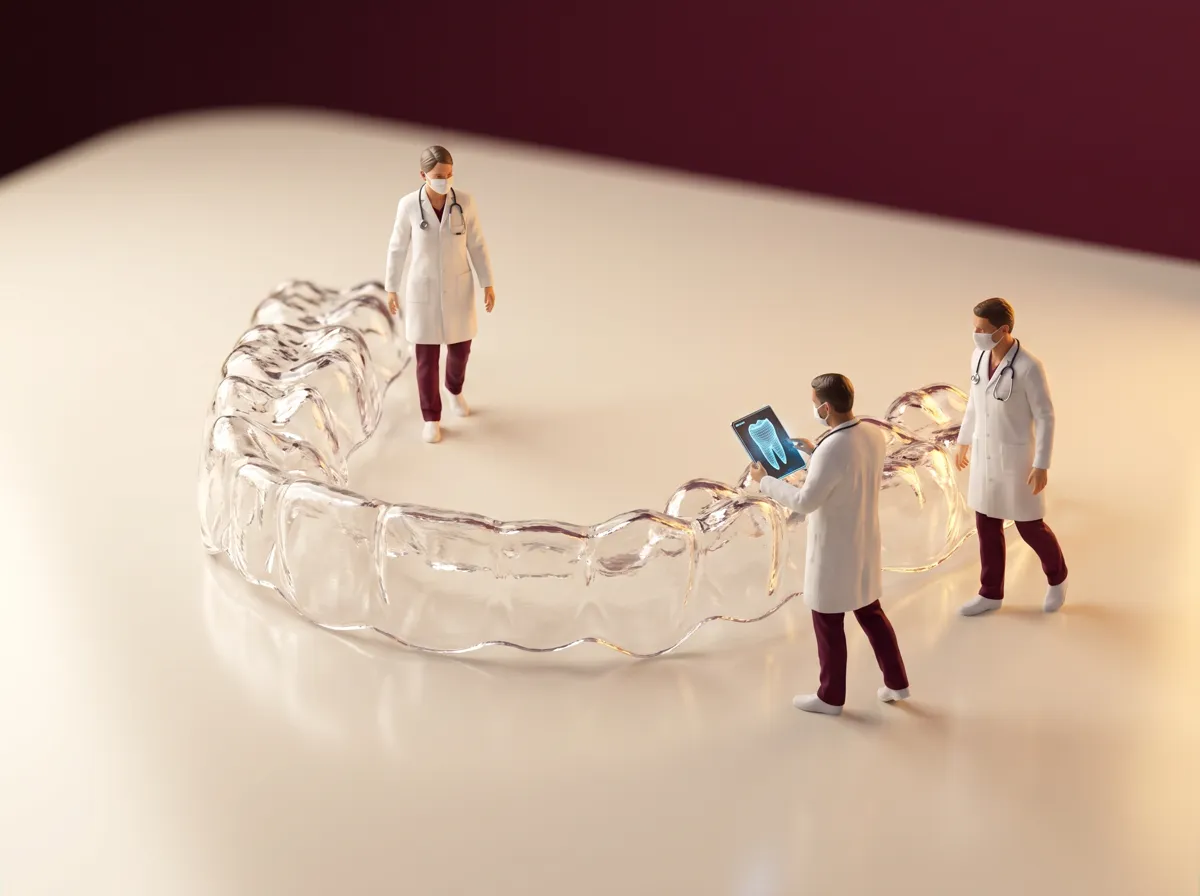
Short answer: both braces and clear aligners straighten teeth well when they suit the case. Clear aligners are transparent and removable, but they only work if you wear them 20 to 22 hours a day. Fixed braces work around the clock and are more predictable for complex bites. The right choice depends on what your teeth need first, then on your lifestyle.
Start with the problem, not the appliance
Most people arrive at a consultation already leaning one way: "I want the invisible one" or "I've heard braces are faster". That is a reasonable starting point, but the appliance is only a tool. What decides the result is the problem being corrected: crowding, gaps, a deep bite, an open bite, teeth that meet edge to edge, or jaws that do not line up.
A specialist orthodontist examines your bite, takes photos and a scan or X-rays, and then tells you which tools can treat it. For many adults with mild crowding, both options are on the table. For some bites, one option is clearly better, and a good orthodontist will say so.
How each one moves teeth
Fixed braces are small brackets bonded to the teeth and joined by a thin archwire. The wire applies steady, gentle pressure, and the orthodontist adjusts it at regular visits every few weeks. Braces stay in place for the whole treatment, commonly one to two years.
Clear aligners are a series of thin, custom-made plastic trays. Each tray is shaped slightly differently from the last, and you move to the next one every one to two weeks. Small tooth-coloured bumps called attachments are often bonded to some teeth so the trays can grip and turn them. Invisalign and EON are two well-known aligner systems.
What the research says
A 2019 systematic review in BMC Oral Health pooled eight studies comparing the two. It found that both clear aligners and fixed braces were effective at treating malocclusion. Aligners had an advantage in moving groups of teeth and in shorter average treatment time. Braces did better at producing good contacts between upper and lower teeth, at controlling the angle of the roots, and at keeping the result stable.
There is an important caveat. An independent commentary pointed out that the quality of the evidence behind these comparisons is very low, because the studies were small and differed in design. So treat the findings as a general picture, not a promise for your own teeth.
Daily life with each option
- Appearance: aligners are close to invisible in photos and at work. Metal braces are visible.
- Eating: aligners come out for meals, so there is no food list, but you must brush before putting them back. With braces you avoid hard and sticky foods that can break a bracket.
- Cleaning: with aligners you brush and floss normally. Braces need extra care around the brackets, because plaque left there can leave white marks on the enamel.
- Speech: some people notice a slight lisp for the first few days with aligners. It usually settles quickly.
- Discipline: aligners only move teeth while they are in your mouth. If they stay in a case for half the day, the plan falls behind. Braces do not depend on remembering.
- Small emergencies: with braces, a loose bracket or a poking wire. With aligners, a lost or cracked tray.
Who tends to suit which
Clear aligners often suit:
- adults and older teens with mild to moderate crowding or spacing
- people who are comfortable wearing them nearly all day, every day
- people for whom a visible brace would really get in the way at work or socially
Fixed braces often suit:
- complex bites, large rotations and big changes in how the teeth meet
- treatment combined with jaw surgery
- younger patients who are likely to forget removable trays
Many cases sit in the middle, and either option can work. That is when lifestyle and budget become the deciding factors.
Questions to ask at your consultation
- What exactly is the problem with my bite, and what happens if I leave it?
- Can both braces and aligners treat it, or is one clearly better for my case?
- How long will treatment take with each option?
- What does the price include: scans, all trays or adjustments, refinements, and retainers?
- How long will I need to wear a retainer afterwards?
Whatever you choose, treatment does not end on the day the braces come off or the last tray is finished. Teeth tend to drift back, so every orthodontic treatment ends with a retainer.
Braces and clear aligners at MOC
At Mohammad Orthodontic Center on 18th November Street in Muscat, our specialist orthodontists offer both fixed braces and clear aligners, including Invisalign and EON. Our founder, Dr Mohammad Zeinalddin, is a consultant orthodontist certified in Invisalign and EON aligners.
Clear aligners are transparent and made to measure for your teeth, and they move teeth with a different mechanism from braces. In Dr Mohammad's experience at MOC, aligner treatment usually finishes 6 to 8 months sooner than braces in cases that suit aligners. Your own timeline depends on your bite and on wearing the aligners as prescribed. In more complex cases, the best plan can be a hybrid treatment that combines aligners and fixed braces.
At your first visit we look at your bite and explain the options that can treat it, with the honest trade-offs of each. Then the choice is yours. If you would like to ask a question before booking, send us a message on WhatsApp and our team will reply.