

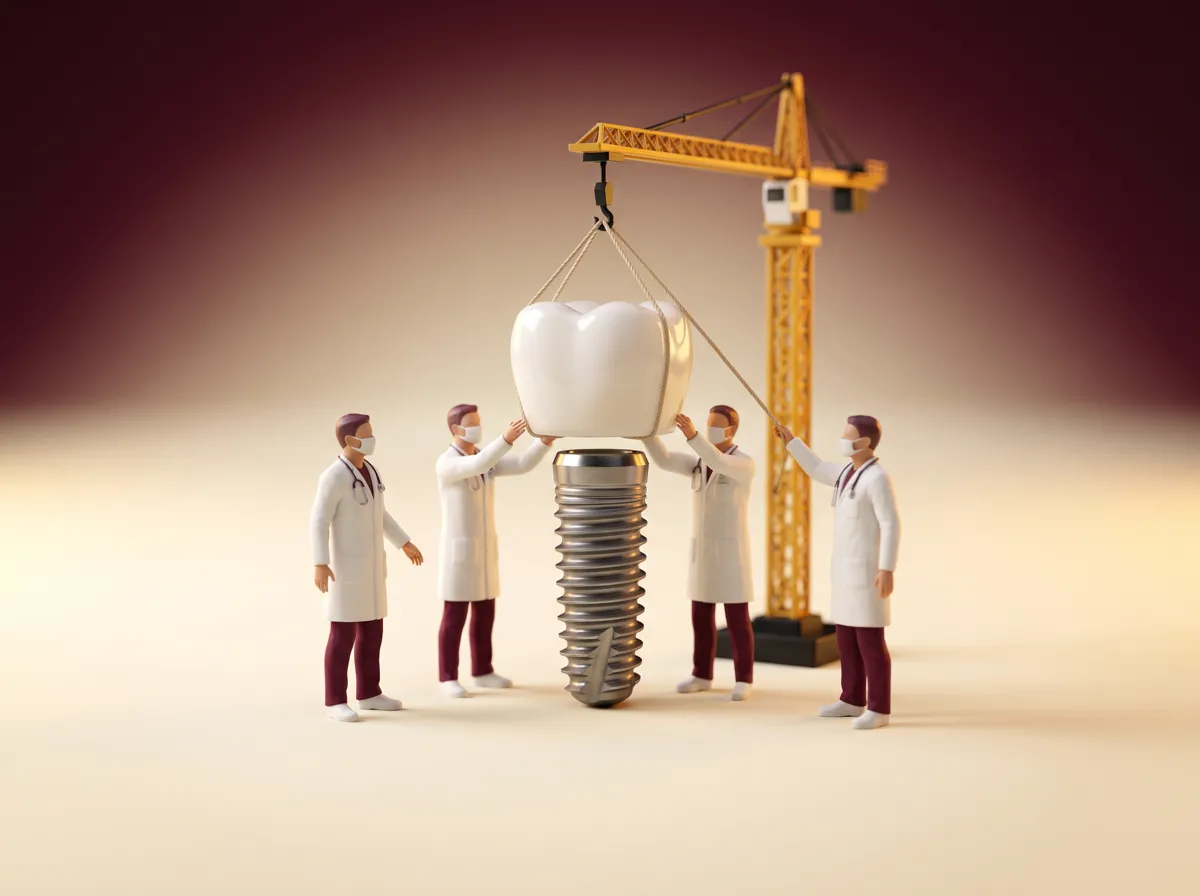
Short answer: a dental implant is a small titanium post placed in the jawbone to hold a crown, bridge or denture. You may be a candidate if you are in reasonable general health, have healthy gums and enough jawbone, and do not smoke. The steps are assessment, planning, placement, healing and then the new tooth. Treatment commonly takes at least a year, and longer if you need a bone graft.
What is a dental implant?
An implant replaces the root of a missing tooth. A small post is placed in the jawbone and left to join with the bone. After it has healed, a crown, a bridge or a denture is fixed to it. A single replacement tooth on an implant does not need support from the teeth beside it.
Who is a candidate for an implant?
Suitability is decided case by case after an examination. An NHS hospital leaflet describes the usual requirements:
- General health: you should be relatively fit and healthy.
- Mouth health: good oral hygiene, stable teeth, and no active decay or infection.
- Enough jawbone: your dentist or surgeon checks the height and volume of bone. If there is not enough, a bone graft may help.
- Not smoking: smokers have a much higher failure rate. The leaflet asks smokers to stop at least six months before treatment.
- Gum disease: success rates are lower in people with gum disease, so it is treated first.
- Teeth grinding: this can overload an implant and reduce its chance of lasting, so tell your surgeon if you grind your teeth.
Tell your surgeon about all your health conditions and medicines at the first visit.
What are the steps, and how long does it take?
- Assessment. You discuss your history and your goals. Standard X-rays are used first, a CT scan may be advised in some cases, and moulds of your teeth help the planning.
- Preparing the mouth. Decay and gum disease are treated before surgery. If needed, a bone graft or sinus lift is done at this stage.
- Placing the implant. The implant is placed in the jawbone in a short surgical visit.
- Healing. The implant is usually left to heal for three to six months, sometimes longer. A two-stage implant needs a small second procedure to uncover it.
- The new tooth. An impression is taken and the crown, bridge or implant-supported denture is attached.
The same leaflet says total treatment time is usually at least one year. Your own timeline depends on how much healing you need and the type of restoration.
What is bone grafting, in plain words?
An implant needs enough bone around it to hold firmly. If bone has shrunk after a tooth was lost, a surgeon can add bone material to build it up. A small amount may be added at the same time as the implant. A larger graft is done at least four months before.
The material can come from your own body (hip, scalp, jaw or chin), from a human bone bank, or from sterilised animal bone (commonly cattle bone), often covered with a thin protective membrane. If you have concerns about animal-derived products, raise them with your surgeon before treatment. The graft acts as a scaffold for your own bone, which takes about four to twelve months to form. A graft can add at least four months to the treatment.
What is a sinus lift?
The sinuses are air spaces above the upper back teeth. Many people who have lost upper back teeth do not have enough bone left to hold an implant. In a sinus lift, the surgeon gently raises the thin lining of the sinus and places graft material underneath it. This builds a base of bone.
- Usual setting: it is typically done awake with local anaesthetic, takes about 45 minutes to two hours, and is an elective procedure.
- Two approaches: in the external approach, a small window is made in the bone, and implants are usually placed after 4 to 9 months. In the internal approach, the implant is often placed during the same visit, which suits cases needing only a small gain in height (about 3 mm).
- Recovery: normal recovery is two to three weeks. From surgery to the final tooth usually takes 6 to 12 months or more.
What are guided (3D-planned) implants?
In guided implant surgery, your surgeon plans the implant position on a 3D scan before the day of surgery. A custom guide, made from the plan, helps steer the drill to the planned position. The aim is to place the implant where the plan intended, in the safest position for nearby nerves, sinuses and neighbouring teeth.
A 2024 systematic review that pooled 53 studies of guided (static) surgery found average differences between the plan and the result of about 1.1 mm at the entry point, 1.4 mm at the tip of the implant, and about 3.6 degrees in angle. It also found that a fully guided approach was more accurate than a pilot-guided one. The authors also point out differences in study design and some risk of bias. In short, guides improve accuracy and do not remove the need for a surgeon's judgement.
What happens after surgery?
- First days: discomfort and swelling are expected, and some discomfort can last about a week. Simple painkillers help, as advised by your surgeon.
- Review: a check about one week later is usual, and stitches may be removed then.
- Sinus lift and graft care: follow the specific instructions you are given. For a sinus lift, these commonly include not blowing your nose for two weeks.
- Cleaning: meticulous cleaning is essential. Poor cleaning can lead to bleeding gums, infection and eventually loss of the implant.
- Check-ups: see your dentist or hygienist every three to six months for monitoring and professional cleaning.
What are the risks?
All surgery carries risk, and a good surgeon explains yours before you decide. The ones listed in NHS hospital leaflets include:
- the implant not joining with the bone and needing to be removed
- infection, especially if aftercare instructions are not followed
- bleeding, and numbness or tingling in the lip, chin or tongue, which usually settles
- gum inflammation or bone loss around the implant (peri-implantitis) when it is not cleaned well
- wear of the new tooth over time, or breakage of the clips or screws that hold a denture
- with a sinus lift, a tear in the sinus lining (the most frequent of the listed problems), swelling, bruising and, less often, infection or loss of the graft
Smoking raises the risk of graft failure and implant failure.
Questions to ask at your consultation
- Am I a good candidate, and what could make my case more difficult?
- Do I need a bone graft or a sinus lift, and how much time would that add?
- Will you use a 3D plan and a surgical guide?
- What is the full timeline, including healing and the final tooth?
- What does the quote include, and what happens if the implant fails?
- How should I clean it, and how often should I be reviewed?
Dental implants at Mohammad Orthodontic Center
At our centre on 18th November Street in Muscat, implants, sinus lift and guided 3D implants are provided by our oral and maxillofacial surgeon and implantologist, Dr Khamis Al Hasani, who is board certified in oral and maxillofacial surgery (OMSB). You can see the rest of the team on our doctors page.
At your first visit we examine your mouth and explain which options suit your case, including the steps and the time they take. If you have a question before booking, send us a message on WhatsApp and our team will reply.