

Short answer: toothache has many causes, from decay and a cracked tooth to gum disease and grinding. See a dentist if pain lasts more than two days, or comes with a fever, a swollen cheek or jaw, or pain when biting. Swelling that makes it hard to breathe, swallow or speak needs a hospital emergency department at once. Root canal treatment removes an infected nerve, then cleans and seals the tooth.
What causes a toothache?
A toothache is a signal, not a diagnosis. The NHS lists these common causes:
- tooth decay
- a dental abscess, which is a pocket of pus from infection
- a cracked or damaged tooth
- a loose or broken filling
- an infection around a wisdom tooth that has not had room to come through
- gum disease
- teeth grinding
- sensitive teeth
- problems with braces
Some of these are minor and some are not, and from the outside they can feel alike. That is why a pain that does not settle deserves an examination and an X-ray, not a guess.
When is a toothache urgent?
Pain that lasts more than two days, or does not ease with painkillers, should be seen by a dentist. The NHS also advises seeing a dentist when the pain comes with a high temperature, pain when you bite, red gums, a bad taste in the mouth, or a swollen cheek or jaw. In practice, call a dentist as early as you can, ideally the same day, if you have any of these.
Go to a hospital emergency department straight away if the toothache comes with:
- swelling around the eye or the neck
- swelling of the mouth or neck that makes it hard to breathe, swallow or speak
Do not drive yourself if you feel unwell. Ask someone to take you, or call the emergency number.
While you wait for an appointment, the NHS suggests an over-the-counter painkiller such as paracetamol or ibuprofen (ask a pharmacist if you are unsure which suits you), soft foods chewed on the other side, and avoiding very hot, very cold and sweet foods.
What is root canal treatment?
Inside every tooth is a soft core called the pulp, which holds nerves and blood vessels. When decay, a crack, gum disease or an abscess lets bacteria reach it, the pulp can become infected. Root canal treatment removes the infection from inside the tooth, then cleans and fills the space so it does not get infected again.
How does a root canal work, step by step?
The American Association of Endodontists and the NHS describe the same basic sequence:
- Examination and X-ray. The dentist checks the tooth and takes an X-ray.
- Anaesthetic. A local anaesthetic numbs the area. You are awake. The aim is that you do not feel pain, and you should tell the dentist if you do.
- Isolation. A thin protective sheet, called a dental dam, keeps the tooth clean and dry.
- Access and cleaning. A small opening is made in the top of the tooth. Very fine instruments remove the infected pulp, and the canals inside the roots are cleaned and shaped. Any abscess is drained.
- Filling. The canals are filled with a rubber-like material called gutta-percha, together with a sealing cement. A temporary filling usually closes the opening.
- Restoration. The tooth is then rebuilt with a permanent filling or a crown.
Why use a microscope?
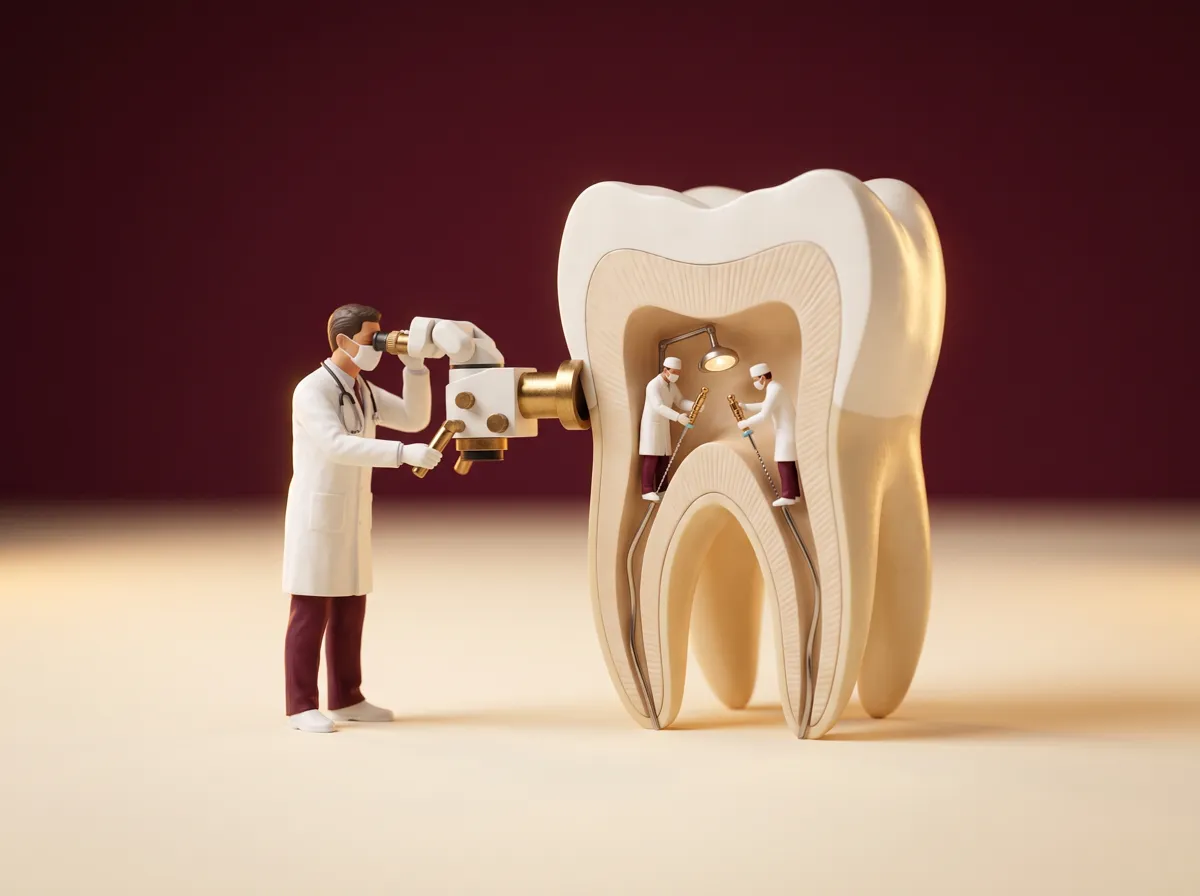
A dental operating microscope enlarges the view inside the tooth and shines a strong light into it. Root canals are narrow and complex, so a clearer view is useful to the person doing the work.
Whether that clearer view leads to better results for patients is a separate question, and the honest answer is that it is not settled. A Cochrane review of magnification devices in endodontics (microscopes, endoscopes and loupes) found no randomised trials that met its criteria. It concluded that it is unknown whether, or how, the type of magnification affects the outcome. Individual studies report differing results. So a microscope is best understood as a tool that helps the dentist see, not as a guarantee.
How many visits, and what about after-care?
The numbers vary by tooth and by clinic. The NHS says treatment usually takes two or more appointments of one to two hours, while the AAE says most root canals take one to two appointments of about 90 minutes. A complicated infection or a tooth with several canals can need more visits.
After treatment:
- Mild soreness or sensitivity for a few days is common. The AAE says it usually improves within three to five days, and the NHS says swelling and soreness should improve within a couple of weeks.
- Over-the-counter pain relief is often enough. Report pain that is severe, getting worse, or lasting longer than expected.
- Avoid chewing on the treated tooth until it has its permanent restoration. Eat softer food meanwhile.
- Brush and floss as normal, and keep your follow-up appointments.
Why do many root-canal-treated teeth need a crown?
A tooth that has had a root canal has often lost a lot of its structure to decay, a crack or the treatment itself. The NHS says a crown, a cap that covers the whole tooth, may be needed if the tooth was badly infected. The AAE says the crown or other restoration is placed after the final root canal visit, and a post may be used inside the tooth if not enough of it remains. Your dentist will tell you whether your tooth needs one.
What are the alternatives?
If an infected tooth is not treated, it may need to be taken out. Extraction removes the tooth and the infection with it. The trade-offs are:
- A gap is left. Neighbouring teeth can drift into it, which can affect chewing and the bite.
- Replacing the tooth, for example with a bridge or an implant, can mean more appointments and sometimes more than one kind of specialist.
- Root canal treatment keeps your own tooth, but the tooth may need a crown afterwards.
Neither route is right for everyone, and the choice depends on the condition of your tooth. Ask your dentist to explain both options for your tooth.
Questions to ask at your consultation
- What do you think is causing my pain, and how do you know?
- Can this tooth be saved, and how likely is it to need a crown afterwards?
- How many visits will treatment take?
- What happens if I choose extraction instead, and how would the gap be replaced?
- What should I do if the pain or swelling gets worse between visits?
Root canal treatment at MOC
Mohammad Orthodontic Center, on 18th November Street in Muscat, offers microscopic root canal treatment by a specialist endodontist, Dr Shahab Javanmardi. His listed qualifications are DDS, MSc Endodontics and a Fellowship in Endodontics.
If you have a toothache and are not sure how urgent it is, send us a message on WhatsApp or call the clinic on +968 2207 7550, and our team will reply. If you have facial swelling that is spreading or makes it hard to breathe or swallow, do not wait for a reply: go to a hospital emergency department.