

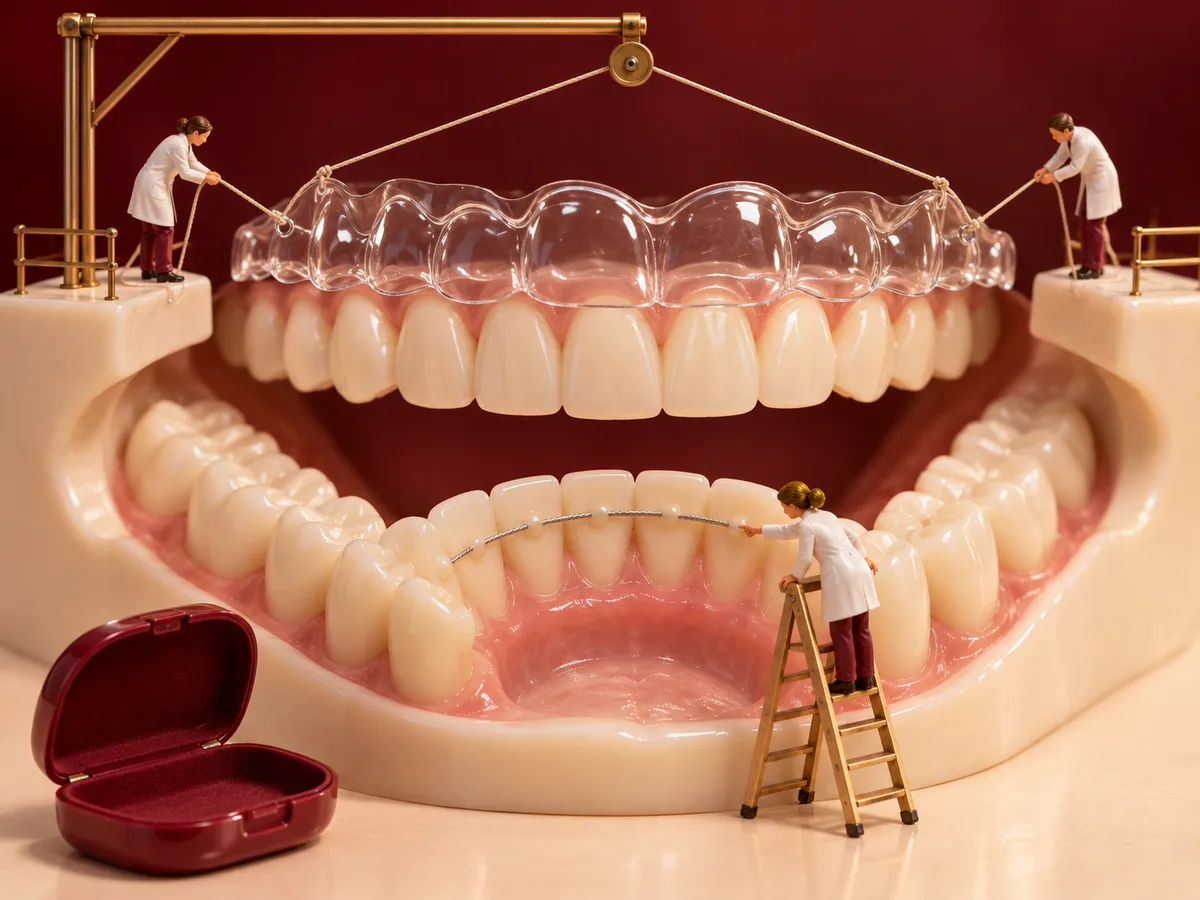
Short answer: after braces or aligners, teeth tend to drift back toward where they started, so almost everyone who finishes orthodontic treatment needs a retainer. It can be a thin wire bonded behind the front teeth or a removable clear or wire retainer. At MOC we usually recommend a clear retainer, worn at least 9 to 10 hours a day at first and fewer hours after the first year.
The day the braces come off is a good day. You run your tongue over smooth teeth, look in the mirror and see the smile you waited months for. Then your orthodontist hands you a small case with a retainer inside, and the obvious question comes up: why do I still need this?
The short version is that straight teeth are not yet settled teeth. This guide explains why teeth move after treatment, the main types of retainer, how long to wear one and how to look after it, so the result stays the way it looks on that first day.
Why do teeth move back after braces?
Braces and aligners move teeth by applying steady pressure. When the pressure stops, the teeth have a natural tendency to return toward their old positions. The American Association of Orthodontists (AAO) explains that a retainer gives the bone and gum around each tooth time to remodel around the new position, and holds the teeth there while that happens.
There is a second, slower reason. Teeth tend to shift and crowd slowly with age, whether or not you ever had braces. A retainer also protects the result against these gradual changes.
Who needs a retainer?
The AAO says retainers are part of treatment for everyone who has had orthodontic treatment. Children and teenagers are included. Their jaws may still be growing, so regular follow-up matters, and parents can help a lot by reminding them to wear it and keeping an eye on how it fits.
What types of retainers are there?
There are three main types. Your orthodontist chooses one, or a combination, based on how your teeth were moved and how likely they are to shift.
Fixed (bonded) retainer
A thin wire is bonded to the inner surface of the front teeth, often the lower ones. You cannot see it from the front and you never have to remember it, because it works all day and night.
It does need attention, though:
- If the bond comes loose or the wire breaks, for example after biting something hard, the teeth can start to move without you noticing. Run your tongue along it now and then, and book a check if anything feels different.
- Plaque builds up easily around the wire, and normal flossing is harder. A floss threader, super floss or a small interdental brush helps.
At MOC, Dr Mohammad does not usually suggest a fixed retainer. In his experience, its drawbacks outweigh the advantage of being fixed.
Clear removable retainer
This is a thin, transparent plastic tray made to fit your teeth exactly. It is popular because it is hard to see, and it comes out for eating and brushing. The AAO notes that clear retainers are sensitive to heat, so they must never go in hot water.
This is the retainer Dr Mohammad usually recommends at MOC. Today's clear retainers hold all the teeth and the curve of the smile, and they are easy to take out for meals and to clean. Their main challenge is that they only work when you wear them as advised.
Hawley retainer
This combines an acrylic plate that sits against the roof or floor of the mouth with a metal wire across the front teeth. It is durable, and the orthodontist can adjust or repair it. It may affect speech slightly for the first few days.
Is one type better than the others?
A Cochrane review updated in 2023 looked at 47 studies with 4,377 adults and children. Its authors concluded that the evidence is not strong enough to call any one type of retainer better than the others, because their confidence in the studies was low. In practice, the best retainer is the one chosen for your teeth by your orthodontist, and the one you actually wear.
How long will I need to wear a retainer?
Your orthodontist sets the schedule for you; as the NHS puts it, the orthodontist will tell you how long to wear it. At MOC, the usual advice is:
- The first year: wear your retainer for at least 9 to 10 hours every day, starting when your braces or aligners come off.
- After the first year: wear it for fewer hours, as your orthodontist advises.
- Long term: the AAO says that most people need to wear a retainer to some degree for the rest of their life, although how often usually goes down over time.
If you have a fixed retainer, it stays in place for as long as your orthodontist recommends, often for years.
How do I look after my retainer?
A clean, well-kept retainer lasts longer and keeps your mouth healthier.
- Brush a removable retainer every day with a soft toothbrush and cool or lukewarm water.
- Soak it about once a week in a retainer-cleaning solution, as the AAO suggests, to stop build-up.
- Keep it away from heat. Hot water can warp it, and so can a hot car. In Muscat, never leave it on the dashboard or in direct sun; keep it in its case and take it with you.
- Put it in its case whenever it is out of your mouth. A lot of retainers get thrown away by accident, wrapped in a napkin at lunch.
- Take it out and put it in gently, with both hands, without bending the wire.
- With a fixed retainer, clean around the wire every day with a floss threader or an interdental brush.
- Bring your retainer to your check-ups. Retainers wear, crack or stop fitting over time, and a check catches this early.
Questions to ask at your retainer appointment
- Which type of retainer do you recommend for me, and why?
- How many hours a day should I wear it, and when can I wear it less?
- How should I clean it, and which products are safe for it?
- What should I do if it feels tight, cracks or gets lost?
- How often should you check my retainer and my teeth?
Retainers at MOC
At Mohammad Orthodontic Center on 18th November Street in Muscat, our specialist orthodontists plan the retainer stage as part of orthodontic treatment with braces or clear aligners, and they can check your retainer and how your teeth are holding. For most patients, we recommend a clear retainer.
If your retainer feels tight, has cracked or has gone missing, contact us soon, before the teeth have time to move. You can call the clinic on +968 2207 7550 or send us a message on WhatsApp at +968 7992 5788. We are at Building 89, 18th November Street, Muscat.