

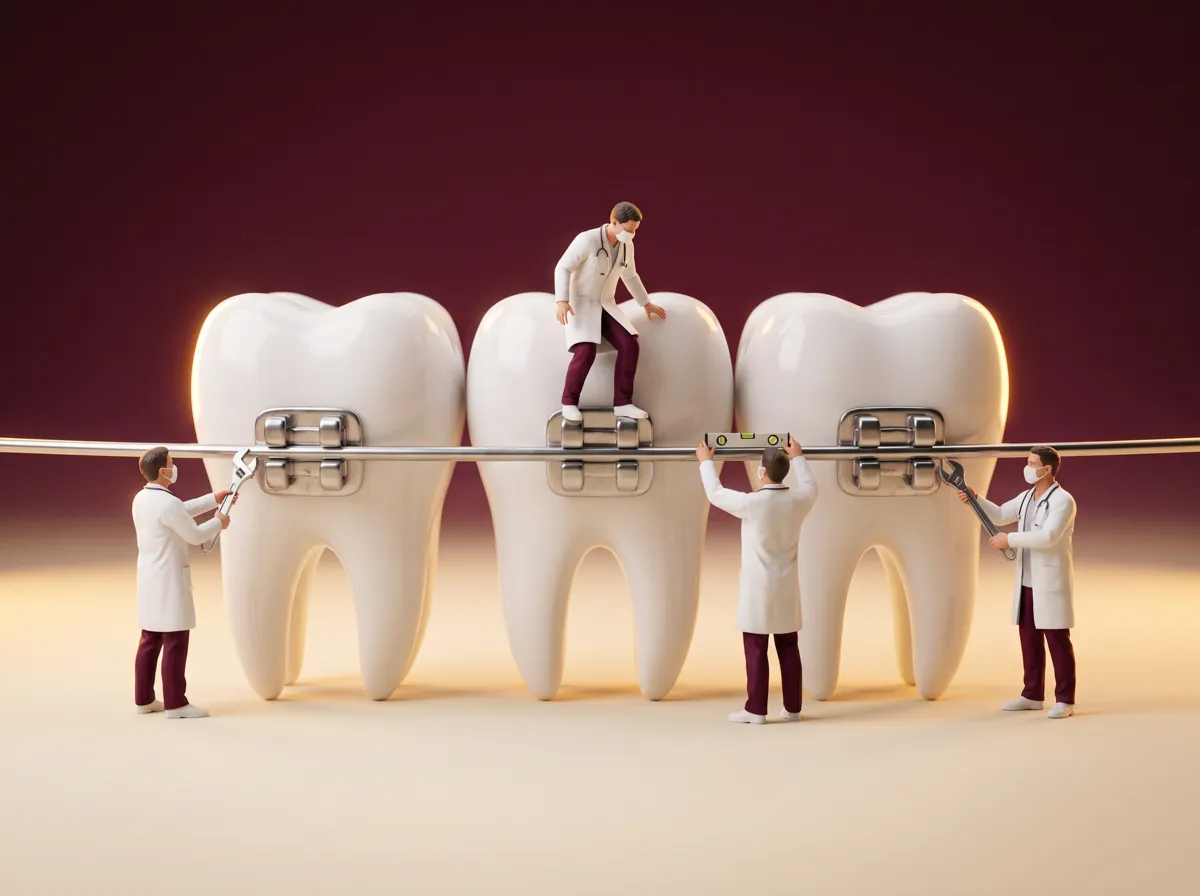
Short answer: braces come in several types, mainly metal, ceramic (tooth-coloured) and lingual (fixed behind the teeth). Treatment follows clear stages: assessment, fitting, adjustment visits every few weeks, removal and then a retainer. Most people wear braces for about 12 to 24 months, though your own time depends on your teeth. The AAO advises a child's first orthodontic check-up no later than age 7.
What are braces, and how do they move teeth?
Braces are small brackets fixed to the teeth and joined by a thin wire. The wire applies gentle, steady pressure, and your teeth slowly move into better positions as the bone around them adapts. Your orthodontist changes or adjusts the wire as treatment goes on. Some patients also need small elastic bands, a palatal expander or headgear for extra force.
People wear braces for crowded or sticking-out teeth, gaps, an overbite or underbite, and teeth that are hard to clean or chew with. This guide covers fixed braces. If you are still deciding between braces and removable trays, read our comparison: braces or clear aligners.
What types of braces are there?
- Metal braces: stainless steel brackets bonded to the front of each tooth. They are the type most commonly used and the one most people picture.
- Ceramic braces: the brackets are clear or tooth-coloured, so they blend in more. The brackets and wires are still visible up close. Ceramic can be more brittle than metal, and the American Association of Orthodontists (AAO) notes that it is not the right choice for everyone.
- Lingual braces: brackets mounted on the tongue side of the teeth, so they are nearly hidden.
- Self-ligating braces: these can be metal or ceramic. A built-in clip holds the wire instead of small elastic ties, which reduces friction and generally allows a longer gap between visits.
Which type suits you depends on your teeth, your bite, your oral health and your daily life. The orthodontist will explain the trade-offs after the examination.
How does treatment go, step by step?
- Examination and records. The orthodontist checks your teeth and jaws and may take photos, X-rays or scans. You discuss the problem, the options and a rough timeline.
- Preparing your mouth. Your dentist may need to treat decay or gum problems before braces are fitted.
- Fitting. Brackets are glued to the teeth and the wire is attached. Your teeth may feel sore for a few days, and soft food and simple painkillers can help.
- Adjustment visits. You come back every 4 to 12 weeks depending on the stage of treatment. The NHS gives 6 to 8 weeks as the usual gap. At each visit the wire or elastics are changed.
- Removal. When the teeth are in position, the braces are taken off and the teeth are cleaned.
- Retainer. A retainer starts straight away to hold the result (see below).
How long will I need braces?
The AAO says most people wear braces for 12 to 24 months, and the NHS gives one to two years. Small corrections can take a few months. Complex cases with many teeth or jaw repositioning can take longer. Skipped appointments and broken brackets can slow progress.
How do I look after teeth with braces?
- Brush with fluoride toothpaste in the morning, at night and after meals.
- Clean between the teeth and under the wire every day with an interdental brush, a water flosser or similar tools.
- Avoid hard, crunchy and sticky foods that can break brackets. Cut apples, carrots and similar foods into small pieces.
- Do not chew gum, because it can get stuck in the braces.
- Limit sugary food and drink, which raise the risk of decay.
- Keep your regular dental check-ups as well as your orthodontic visits.
What if something breaks?
Contact your orthodontist as soon as a wire or bracket breaks, so they can tell you what to do and whether to come in early. Orthodontic wax can cover a sharp edge temporarily. The NHS also advises contacting the orthodontist if soreness lasts more than a few days after fitting, or if your gums become very red, swollen or painful.
Why do I need a retainer?
Teeth tend to drift back after braces. A retainer holds them in their new position while the bone around them settles. There are two kinds. A removable retainer is either a clear plastic tray or a wire-and-acrylic (Hawley) type. A fixed retainer is a thin wire bonded to the inside of the teeth.
The AAO says retainers are typically needed for life, though you may wear them less often over time. Your orthodontist will set the schedule. Clean a removable retainer daily with a soft toothbrush and water (not hot), keep it in its case when it is not in your mouth, and avoid hot water. If it no longer fits, contact your orthodontist. Our guide to retainers after braces goes into more detail.
When should a child first see an orthodontist?
The AAO recommends a first check-up with an orthodontist no later than age 7, when a child has a mix of baby and permanent teeth. At that visit the orthodontist can spot problems early and estimate how long any treatment would take. Many patients start treatment between ages 9 and 16, so an early visit does not mean braces right away. A child who is older than 7 is not too late for a first visit.
Questions to ask at your consultation
- What is the problem with my bite, and what happens if I leave it?
- Which type of braces do you recommend for me, and why?
- How long will treatment take, and how often will I come in?
- What does the quote include: adjustments, repairs, removal and retainers?
- How long will I wear my retainer, and what kind will it be?
Braces at Mohammad Orthodontic Center
At our centre on 18th November Street in Muscat, our specialist orthodontists provide braces, clear aligners and children's orthodontics. Our founder, Dr Mohammad Zeinalddin, is a consultant orthodontist. You can meet the whole team on our doctors page.
At your first visit we examine your bite, explain the options that can treat it and the honest trade-offs of each, and then the choice is yours. If you have a question before booking, send us a message on WhatsApp and our team will reply.